
Energy from waves
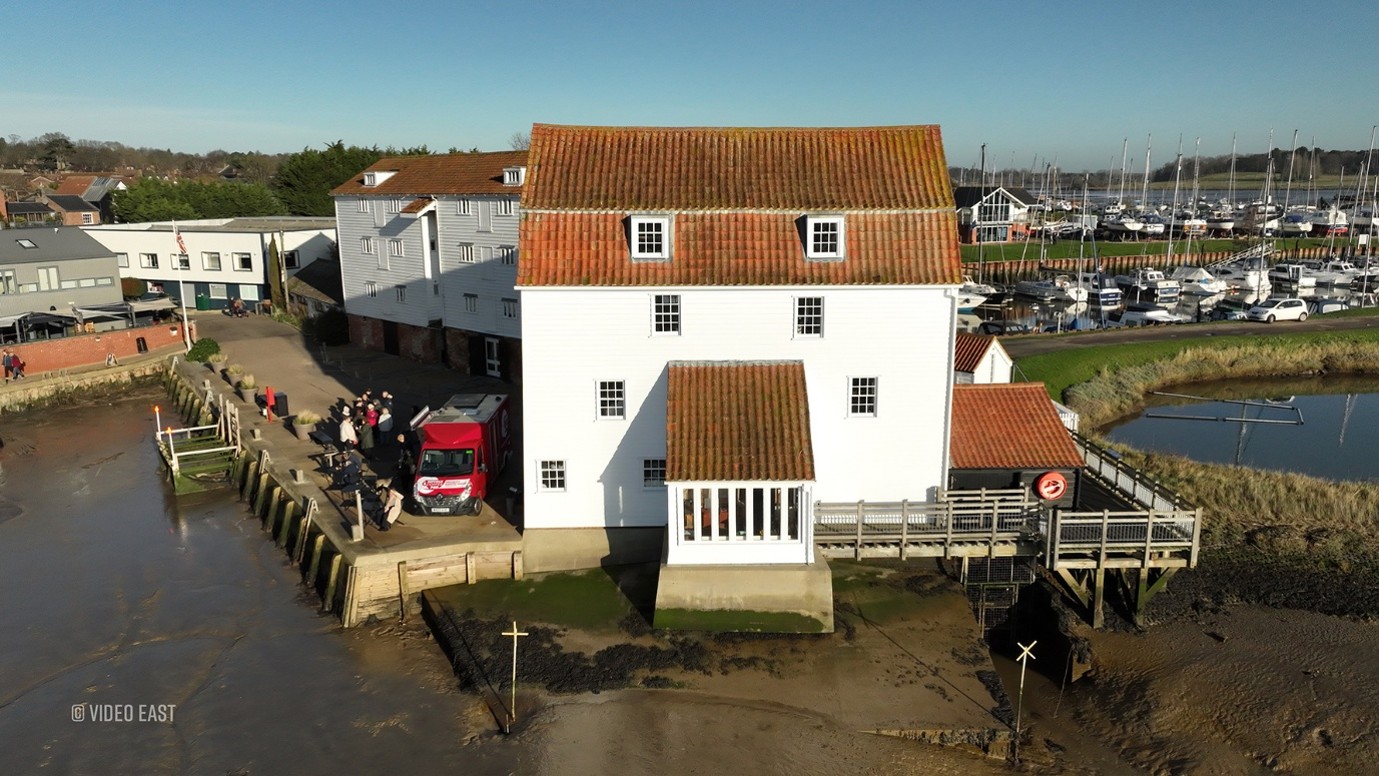
The world’s seas and oceans are seldom at rest. There is a continuous cycle of ebb and flood, which has been used for centuries in tidal installations, such as Woodbridge Tide Mill in England. A basin is filled by the rising water, then discharged via a water wheel to supply energy. This source is predictable, but energy is only supplied part of the time1.
Currents occur in seas and oceans. Tidal currents are closely linked to ebb and flood and reverse their direction, but other currents are always in the same direction, such as the gulf stream, or depend on the atmospheric pressure, and winds, such as the current in the Skagerrak between Denmark, and Sweden and Norway2.
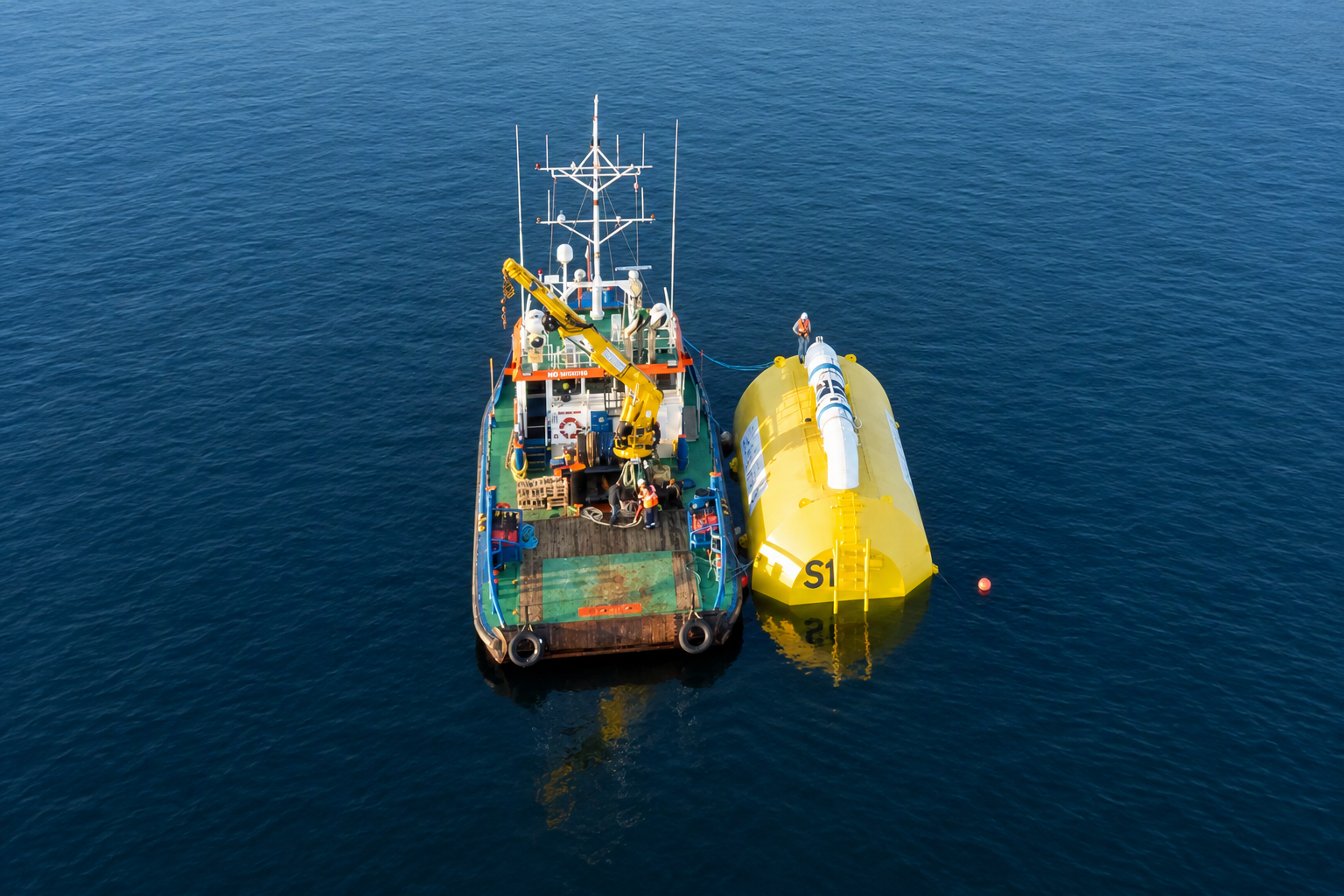
Waves can be a source of energy, too. The surface of the seas is rarely completely at rest, though this depends on location. Waves affect all buoyant objects, such as ships and buoys, which move in response. This motion can be used to generate energy, and this is the principle of Seaturns. Let’s look at how it works, then look at the numbers. Is it a good idea? Can we understand the design choices?
The system: description
It is an interesting property of surface waves that they cause an elliptical motion of each surface particle. At the crest of the wave, the surface moves in the direction of wave-propagation, in the trough, it moves in the opposite direction; it returns to the initial position.3 4
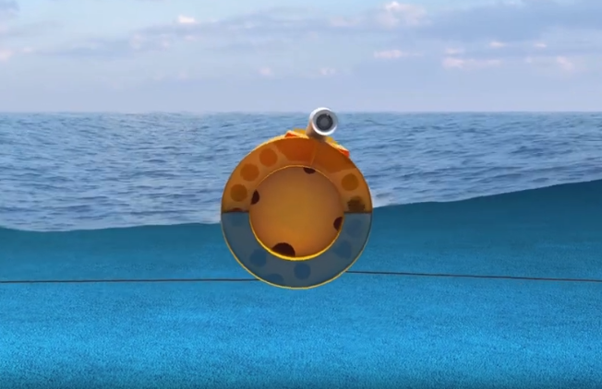
The Seaturns buoys are held stationary at the bottom by a rope, and as the buoy is moved by the wave, it rotates to and fro. This is partly caused by the circular motion of the water, and partly by the height difference at the two sides of the buoy. Inside the buoy, some water tries to remain stationary, so that it rocks relative to the buoy. As a result, two compartments at the top, separated by a wall which is vertical when the buoy is in the central position, are alternately inundated and vacated by the water. This pushes air from one compartment to the other, via a tube mounted on top of the buoy. This tube contains a turbine, which converts the air movement/pressure to electric energy.
The advantages of Seaturns over wind turbines are described on the Seaturns website. The main advantage is that the buoys only require two anchors for ten buoys on a shared line, instead of the massive foundation of a wind turbine mast. Installation can be done by a relatively small boat, without the need for high cranes (or any cranes; the buoys can be towed to their destination. Maintenance, preventive or corrective, can be done onshore after exchanging a buoy by a replacement.
Waves are not always present, but they persist for some time after the wind has died down. Thus, the time without waves is shorter than the time without wind, even though the swell needs time to build up.
The numbers
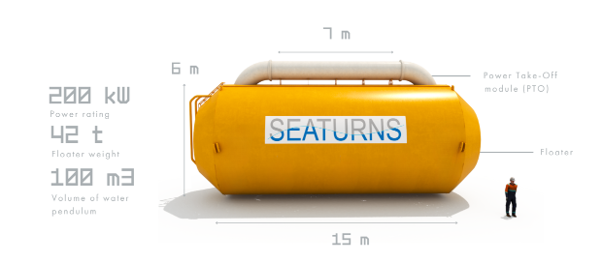
A floater of 15 m long, 6 m diameter, weighing 42 tons, containing 100 m3 of water, is rated at 200 kW. It is not clear for which range of wave heights the rated power can be achieved.
Calculations
a) period and amplitude of oscillation
This can be estimated. There are two possible rotation mechanisms:
- Assuming the bottom stationary in the x-direction, the buoy rolls. Rotation does not give righting moment. Movement caused by wave (top moved back and forth); as a good approximation, we may take the period of the wave as the period of the buoy movement, and the maximum angle as the maximum height difference on either side of the buoy divided by the diameter. For a wave with a wavelength of 30 m and a wave height of 1.5 m, this gives a height difference of 0.2 m, and thus an angle of merely 2 degrees, and an oscillation time of 4.5 s 5. This is small and therefor probably not the main motive mechanism.
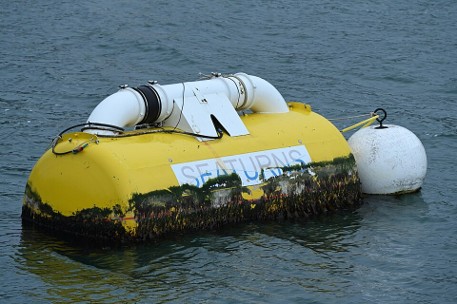
- The water at the surface in a wave moves in a circle (for deep water) with the same diameter as the wave height (clearly!). For 1.5 m high waves and a 6 m diameter buoy, this would mean the whole buoy could move 1.5 m in the centre, giving an angle of rotation about the bottom (which is held at constant horizontal position) of 2*arctan(1/4) or 28 degrees. The photograp with the algae below suggests this is approximately correct. There seems no need for more complicated dynamics. The angle would, however, depend on the wave height, but also on the buoy dimensions and the anchoring; it is clear that the buoy’s rotation is limited by the cable too.
b) energy
It appears the buoy contains just enough water to make it float with the top half exposed. Since steel is heavier than water, the volume of water must be less than half the volume of the buoy. The cross section suggests the water occupies the third of the cross section radially, and half the buoy height, or 5/18 (28%) of the buoy volume. In fact, the diagram below shows it is 100 m3, or 24% of the volume of a 6 m diameter cylinder with length 15 m. The floater weight of 42 000 kg is evidently not including the water pendulum (100 000 litres).
The water in the buoy, moving, say, 30 degrees (1/6 of the arc it occupies) displaces 1/6 *100 m3 every 4.5 s, or 3.7 m3/s. How much energy can be generated in the Power Take-Off module?
This is not an easy question, because air is compressible. If the energy was generated by water turbines, it would be easier. But it isn’t.6 Let’s make a rough order of magnitude calculation. Assuming the pressure in the air is increased by 0.1 bar on the pressure side and reduced by (almost) 0.1 bar on the other side, then the compression energy is 0.2*105 Pa* 3.7 m3/s = 74000 W. If this can be harvested with 50% efficiency, then 37 kW remains. This estimate is lower than the 200 kW stated by Seaturns, but close enough to give some confidence; after all, the Power rating by Seaturns probably applies to situations with higher waves.
c) cost
To start with the easy part, the space taken up by the Seaturns, we look at the number of floats in the animation on the Seaturns website. It seems there is 1.5 wavelenght between floats on the same two lines, and 8 float lengths between two rows, so each float is in (1.5 x 30)x(8 x 15) m2 = 5400 m2. The rated power density is then 200 kW/5400 m2 or 37 MW/km2 . We compare this to a typical wind park: the Thorntonbank Wind Farm of the coast of Belgium7, which has a rated power of 325 MW on 20 km2, or 16.25 MW/ km2. Seaturns has a 2.25 times higher energy density per sea surface area. On its website, Seaturns claims a factor of 3 to 5, which could mean the floats are a little closer together.
The cost of the Seaturns and of the installation is not disclosed on the website. Let’s compare the cost with the large REpower 6M8 wind turbine (6.15 MW, mast height 80 – 95 m, rotor diameter 126 m, cost roughly 25 million Euros a piece, or 1.3 GEuro for 54 turbines7). The question is how the cost of one wind turbine of this type compares to the cost of 31 Seaturns. The Seaturns float is roughly the same diameter as the mast, and roughly the same size as the nacelle. If the mast extends 15 m. below sea level, the outer structure of the wind turbine mast and nacelle is roughly equivalent to 8 floats. Since the wind turbine mast has to be much stronger, it is likely that the structures contain equal amounts of steel.
The electrics would not be very different per kW. The very large and heavy rotor of the wind turbine and the gearbox are probably more expensive than the much smaller elements in the Seaturns power module (almost certainly without gears, much smaller size).
Installation of the wind turbine, and maintenance too, are probably very costly, but whether it is more expensive to maintain one wind turbine or 31 floats, it is difficult to say. Installation costs are bound to be much lower for the Seaturns.
The best cost information on the Seaturns would be information from the manufacturer, but that information has not been received yet.
This means that only a more detailed study could indicate the cost of Seaturns. The reader may draw their own conclusions, but Reden Makes Sense prefers numbers over intuition.
Safety and ecological impact
The risk of collision between a ship and a wind turbine or a field of Seaturns is comparable, although a wind turbine is more conspicuous. The effect is probably smaller for a collision with a Seaturns float. For aeroplanes, the floats are clearly less dangerous. However, for boats and planes, good navigation is sufficient to avoid collisions.
For birds, the floats are much less dangerous. In addition, Seaturns claims less invasive mooring and a lower impact on marine live due to the smaller footprint, which makes sense.
Discussion
The numbers given by Seaturns roughly agree with our calculations. The idea appears both practical and economical. Seaturns uses simple basic components, requiring no high tech materials to construct.
An interesting design choice is to use an air turbine instead of a water turbine; the water moves as much between the two sides of the float as the air. Each conversion leads to losses. In the case of air, compression and expansion are never reversible, so useful energy is lost9. The choice for air as an intermediate makes sense, though. A practical advantage is that all electrical equipment can now be positioned on top of the float at an accessible position. Another advantage is that the air can be made to flow with a higher velocity, which requires a smaller air turbine. If the water was forced to flow through a turbine, this might lead to more wear and resistance. Another advantage may be that the air is likely to remain clean longer than the water, in which algae might develop, which could foul a water turbine. This design choice, therefore, is entirely understandable.
Conclusion
The Seaturns method of harvesting wave energy looks like a very robust and economic method. The numbers (even if some have to be estimated) largely support the claims made. The energy density is higher than that of wind turbines. The system is constructed from materials that are cheap and can be recycled. Access for maintenance and repair is easy (at least on calm days). Wave energy is just as (un-)reliable as wind, though waves persist for some time after the wind has died down. The impact on the view from the land is much less10.
Let’s see what happens to this interesting idea!
1 only when the tide is lower than high tide. In theory, this could be nearly all the time, if a very large basin were filled instantly at high water.
2 if there is a high pressure area over the Baltic Sea, and a low pressure area over the North Sea, water flows to the west. A pressure difference of 50 mbar corresponds to a water level difference of 0.5 m! The average currents in the Skagerrak are due to a) the inflow into the Baltic of many rivers, b) the salinity difference with the North Sea (salt water flows into the Baltic at depth, less salty water flows out at the surface), and c) the large scale eddy flowing counterclockwise along the Danish west coast and the Norwegion southwest coast.
3 for an explanation, and for the conditions, see Lamb, Hydrodynamics, 1932, p. 366.
4 this is true for the first approximation of the wave form. Stokes found there is a small drift (known as Stokes drift) if the second order is taken into account; a particle on the surface is moved a little distance as each wave passes. For moderate waves, as caused by a wind of 4 Bft, (wave height 1.5 m, wavelength 30 metres), the drift is 600 m per hour. In this time, each wave has travelled 20 km, so the first approximation (closed circles, no drift) is not unreasonable. However, for drifting objects, the second order is crucial.
5 the wave propagation velocity c is given by c=√(gL/2p), so the oscillation time is L/c=√(2pL/g).
6 using water turbines would eliminate a conversion step and compressibility losses. It would complicate the maintenance, if any was needed.
7Thorntonbank Wind Farm - Wikipedia
9 what is really meant is ‘exergy’ but this is, sadly, not a widely known concept. It has to do with the fact that, although energy is always conserved, it tends to less useful forms. Electric energy is very useful (it can be converted completely to heat), heat is less useful (it can be partly converted, more if the temperature is high, less if the temperature is low).
10 The distance at which an object with height H can be seen from the beach for a given h (height of eye above sea level) is 3568*(√H+√h) = (h.o.e. = 2 m) = 5.0 km + 6.2 km = 11.2 km for the floats and 5.0 + 11.3 = 16.3 km for the wind turbine masts.


