
In a previous article (“Stable Hydrogen Supply from Solar and Wind”), the basic problem was described, and a simplified example was analysed. The analysis of the real case, with real climate data and realistic equipment reaction times and conversion losses, was promised for a future Reden Makes Sense column. This is it. It will become clear that the real case is much more complicated, and this makes even the simplest question difficult. For example, suppose you want to know (as you would expect) if producing hydrogen in a tropical island location is cheaper than inland in the Netherlands, how can you be sure? You need to compare the two locations, but not with the same installation, because the best installation for one location is not the best for another location. If you compare a poor solution for one location with a good solution for the other, you might draw the wrong conclusion, and build in the wrong location. You want to be confident that you compare two ‘optimal’ solutions (quite different!) for the two locations.
First, let’s look at the plant and how the complex design problem can be tackled using Reves DSE.
The Hydrogen Plant
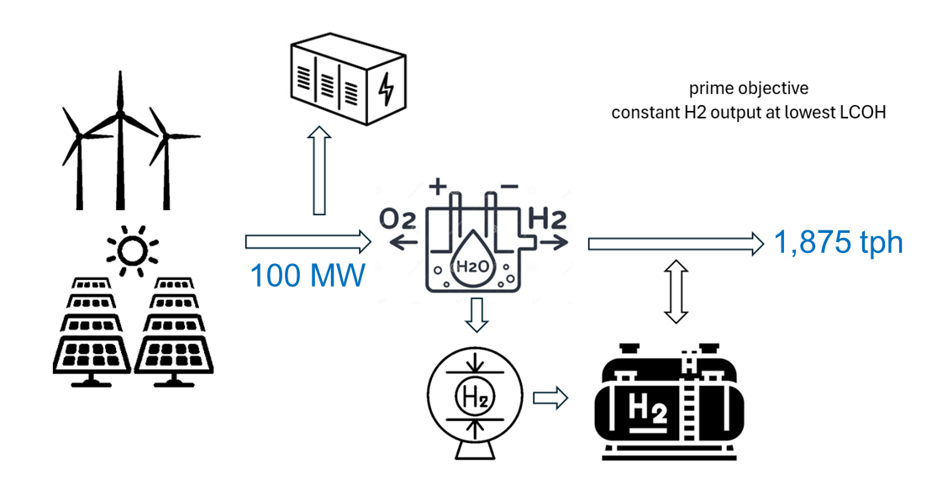
The showcase is a green H2 production plant, which uses 100 MW of electric energy to produce 1875 ton per hour of hydrogen. The LCOH (levelised cost of hydrogen) should be as low as possible.
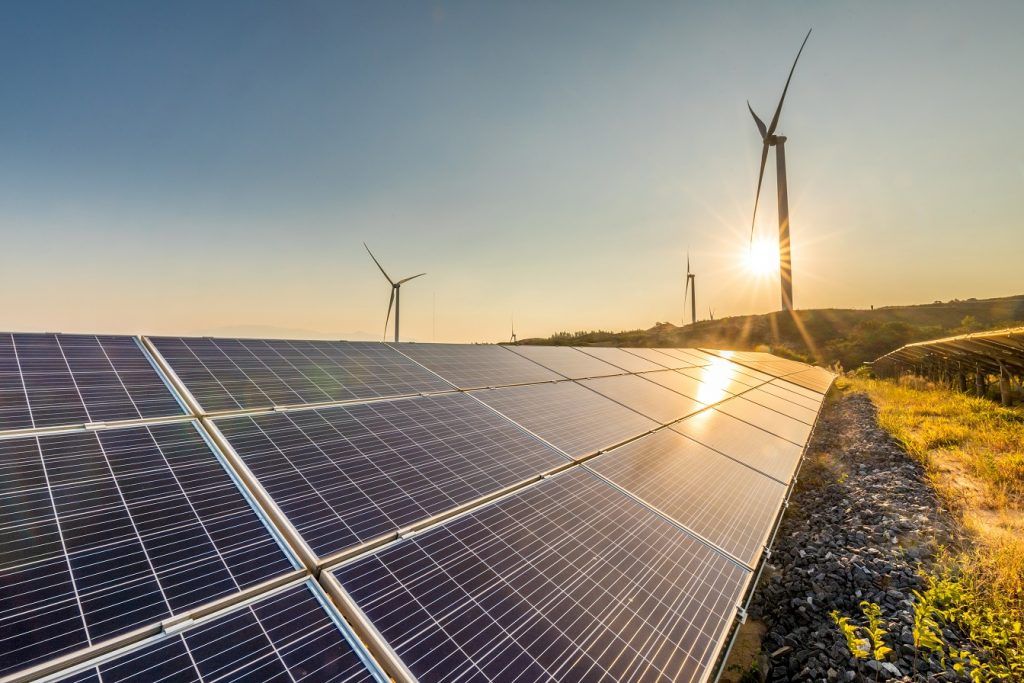
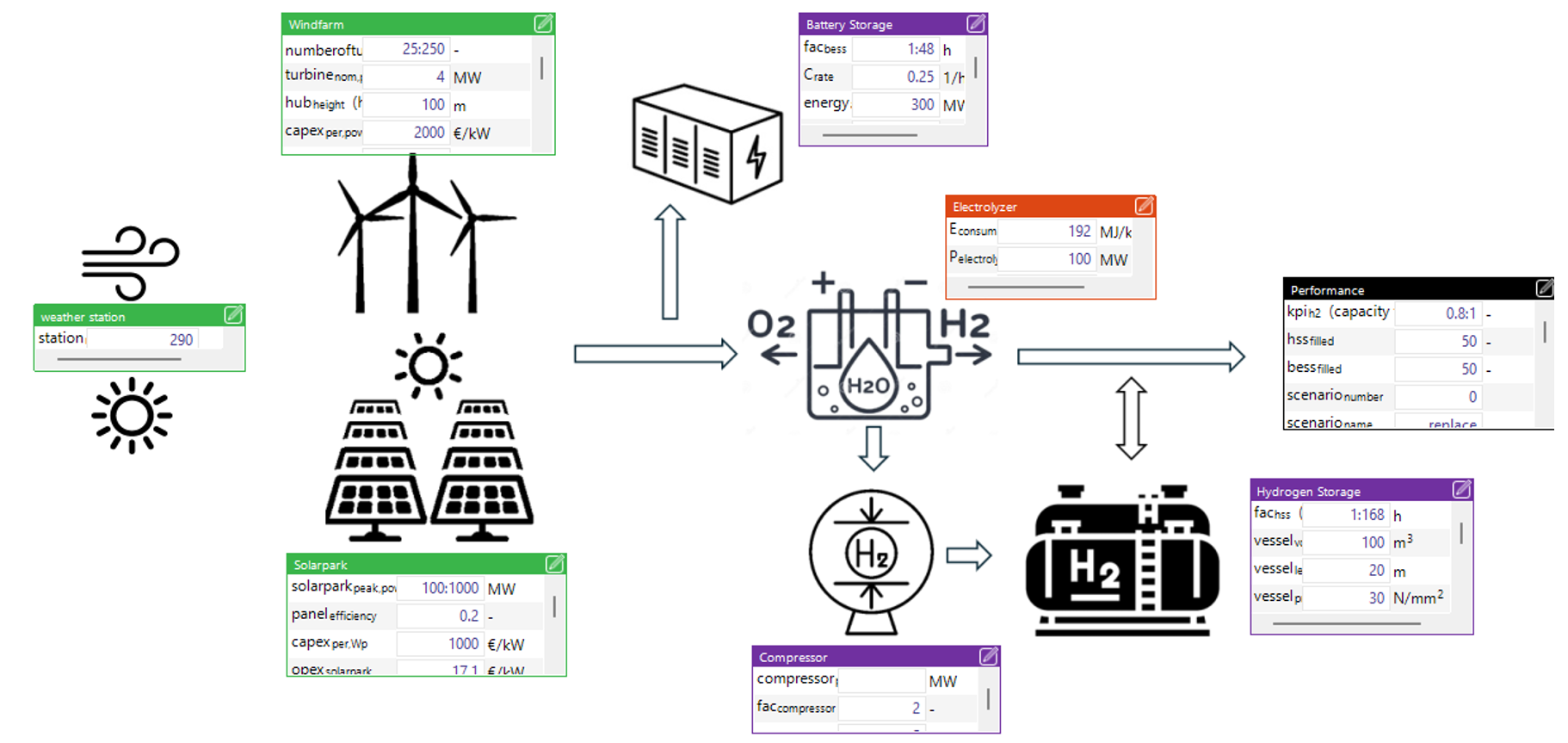
Electricity is generated by solar panels and wind turbines. It is used for driving the electrolyser, which separates water in hydrogen and oxygen, and for charging a battery. The hydrogen is delivered to the customer, or compressed and stored in tanks. The stored electric energy and hydrogen can be used when there is insufficient electricity generation.
In the model, the weather data from meteorological observations by KNMI are used. [1]
The design problem
Imagine you want to know if an installation like this makes sense from a technical and economical point of view. It is obvious that it all depends on the design of the installation, with many parameters to set, and the weather. You could start by selecting values for all parameters, such as the storage capacity of the electric batteries and the hydrogen tanks, then simulating the performance of your initial design with historic weather data. You might find that there is insufficient hydrogen available on 23 days, and try what happens if you increase the tank capacity. But how does this compare to increasing the battery capacity, or installing more wind turbines? Which combination is the cheapest? With six main parameters, and many secondary parameters, such as the cost of compressing hydrogen, finding an optimum is a challenge; there are simply too many possible combinations, and each combination may work well for a part of the year, but disappoint too frequently, with disruptions in hydrogen delivery leading to claims from the customer.
The solution using Reves DSE
Reves DSE (Design Space Exploration) works by showing many possible solutions (solutions which satisfy the physics and are within constraints set by the user), and their performance. The input screen let you define parameters or paramater ranges (in the example below: 25 – 250 wind turbines, 100 – 1000 MW of installed peak power in the solar park, for instance). Reves DSE samples points in the multi-dimensional space, checks if they are valid solutions, and then presents them in simple plots. The validity check, in this case, includes a full simulation for a whole year of historic weather data; this calculation is done in a python code. Reves selects the parameters, python uses them to simulate the performance, and returns the performance score to Reves.
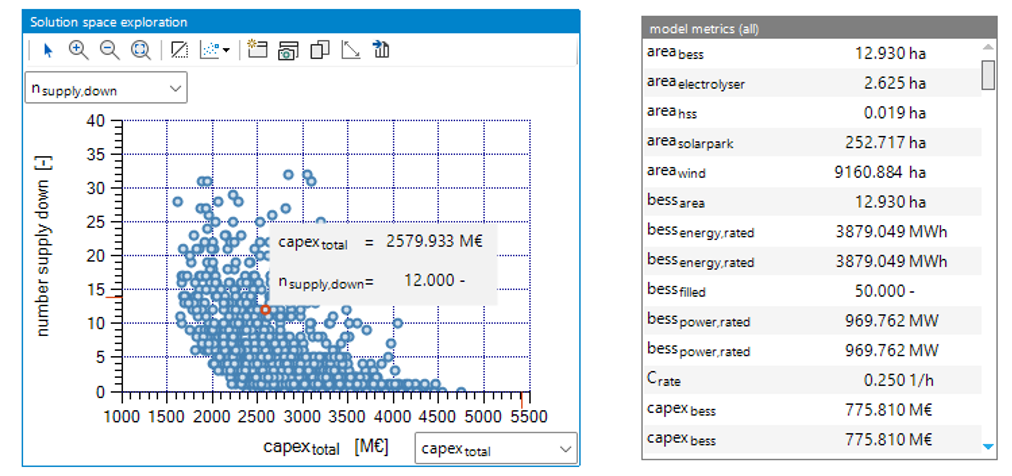
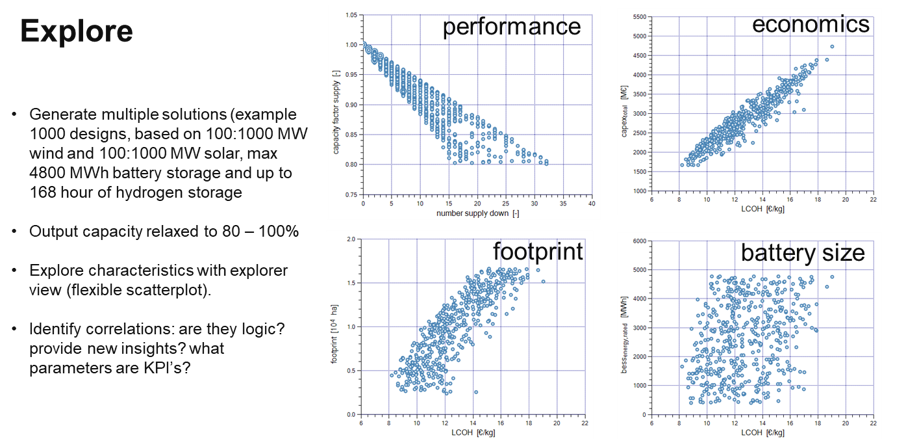
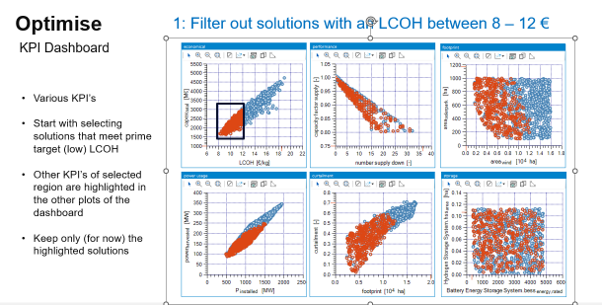
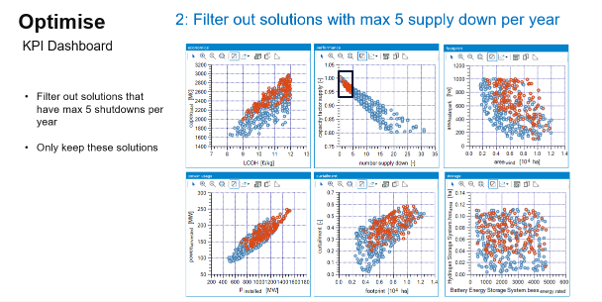
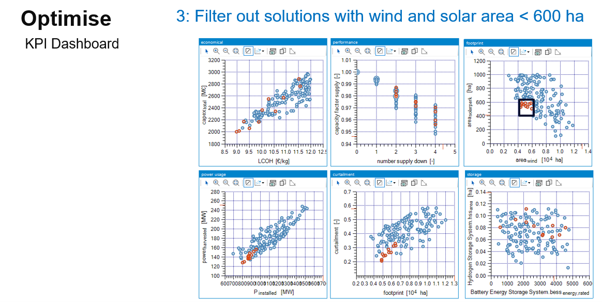
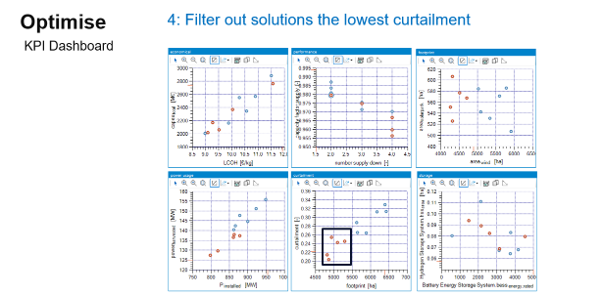
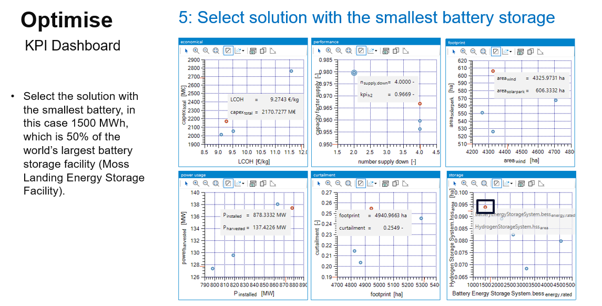
The design problem is now a lot simpler. You can select which parameters you want to plot, and select the solutions you want. This is shown in the next figure. The selection of a favourite is done in 5 steps:
- Filter out solutions with Levelised Cost of Hydrogen below € 12 per kg.
- Filter those with at most 5 moments per year that supply of hydrogen cannot meet demand.
- Filter those with a size requirement of less than 600 hectares (6 km2).
- Filter those with the lowest curtailment. [2]
- then those with the smallest battery storage.
You can select your favourite solution in many different ways, depending on your priorities.
Location
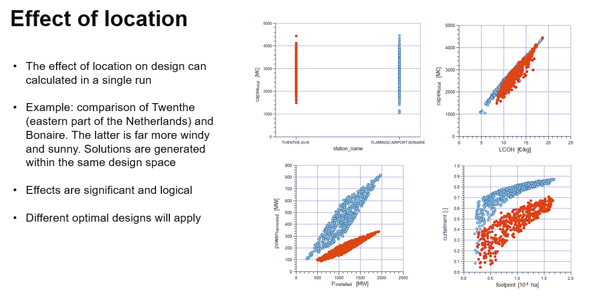
The effect of location can be made visible with this tool, too. See below the difference between the east of the Netherlands and the Caribean island of Bonaire.
Examples
With this model, it is easy to assess different scenarios, with confidence that only good solutions are chosen. As an example, we look at a land based installation in Twente. We specify a nominal output of 100 MW worth of hydrogen, with 80% as the minimum that can be delivered before it counts as a ‘supply down’ event. The results are presented in the graphs below.
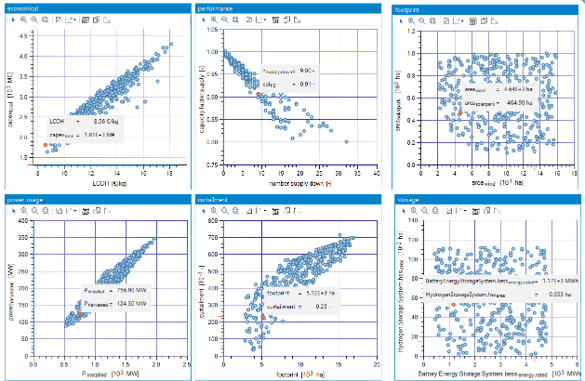
We select solutions with Levelised cost of Hydrogen below € 10/kg, capex below € 2 bn, number of supply downs below 10 per year, and find there is a solution with the following parameters (amongst others).
What do we learn from this example? Keep in mind that it is a situation which was selected carefully from the cloud of possible solutions, as the one we like best.
- For this large capacity, a very large installation is needed. The installed power (max. of solar panels and wind turbines) is 7 times the hydrogen output, and the average power is only 14% above what we need.
- A very large battery AND many large hydrogen tanks are needed to guarantee supply continuity.
- Both cost and land use are impressive.
- Hydrogen generated in this way is (energy content (Higher Heating Value) 142 MJ/kg) has a price per kWh of € 8.56/142MJ*3.6 MJ/kWh = € 0.22/kWh. This is roughly the same as the electricitricity price for industry in the Netherlands. [3]
The most important advantage of this method of designing is that we can be confident that the selected solution is very nearly optimal for the chosen constraints.
Location effect
Since the weather and the length of day and night are very important for the energy supply, it makes a big difference where we build the installation. A large contrast can be expected between Twente (inland, 52° N) and Bonaire (Caribean island, 12° N). The following example will show that the optimal design for one location is not suitable for another. Bonaire is a much more favourable location, according to this analysis, with LCOH als low as € 6.22 per kg. However, not all location dependent aspects have been taken into account in the model. It might be, for instance, that a demand for 100 MW worth of constant hydrogen supply is present in one location, and not in the other.
The table shows the significant effect of placing a plant optimised for Twente in Bonaire, with completely different weather, and no 16 h. nights in the winter. The plant performs better, with no supply interruptions, and cheaper hydrogen. However, a plant optimised for Bonaire is 18% cheaper, uses almost 50 % less land/sea area, and produces 20 % cheaper hydrogen than the plant optimised for Twente. The opposite, building a plant optimised for Bonaire in Twente, has more dramatic effects. It is cheaper than the optimal plant, but fails to supply 24 times per year. Although the hydrogen seems 3% cheaper, this advantage will probably disappear by the claims from a frustrated customer!
Conclusion
A design problem with many parameters can be solved efficiently using Reves DSE. The approach of DSE is to generate many solutions. Looking at these solutions from different angles allows the designer to select the solutions which satisfy the requirements best.
The large scale generation of hydrogen can compete with electricity on a €/kWh basis. A large part of the cost is caused by the requirement to have a constant supply, which leads to significant storage costs and overdimensioning of the solar panel park and the wind turbines.
A location with more constant wind and sun leads to cheaper hydrogen.
[1] KNMI - Daggegevens van het weer in Nederland gives the data per day for a number of stations, but we use 10 minute data from KNMI.
[2] Curtailment means energy that is ‘missed’ by switching off a part of the wind turbines or solar panel, as a fraction the total energy that could have been generated. An example: if the wind and sun power is such that the installation could generate 250 MW, but at that time, the battery is full, the electrolyser can use 150 MW, then 100 MW of potential power is ‘missed.’ If this occurs for 200 hrs and the total energy (without curtailment) for the year is 400,000 MWh, then the curtailment for the year would be 200*100 MWh/400,000 MWh = 0.05. Curtailment would not be a problem if the installation would be connected to the grid! High curtailment is not a problem in itself, but it is probably linked to high costs. Filtering on cost would give similar selections.
[3] Prijs per kWh Elektriciteit Zakelijk 2026 consulted on 1 June 2026. Likely to vary considerably over time!


