

Introduction
The Reden JumpStart is a service to bridge the gap between the innovator and the investor (see Jumpstart - For innovators and investors). The aim is to help the development by giving confidence to the investor and guidance to the innovator. This practical case shows that it can lead to surprising results.
Rator
Rator approached Reden with the request for support in designing important details of their innovative active radiator concept. This concept for domestic heating upgrading is based on the idea that a Peltier element can be used as a solid state electric heat pump. For heating, it can lift low temperature heat to a higher temperature. This gives the radiator a higher power, whereas the central heater can operate at lower water temperatures, and hence better efficiencies, while enabling each active radiator to supply heat to the room at a higher temperature. For cooling, the idea is to use the Peltier elements to remove heat from the room without the need for cold supply water from the central system (which would lead to condensation on the central heating pipes).
JumpStart
Instead of focusing on the design detail, Reden suggested to do a JumpStart on the Rator proposition. It was a step away from the daily duties of the Rator crew. Instead of working feverishly to finish prototypes in time for a large test (including finalising the design), Rator took the time to let Reden judge the value and maturity of their concept and advise on the next development steps.
Reden’s analysis
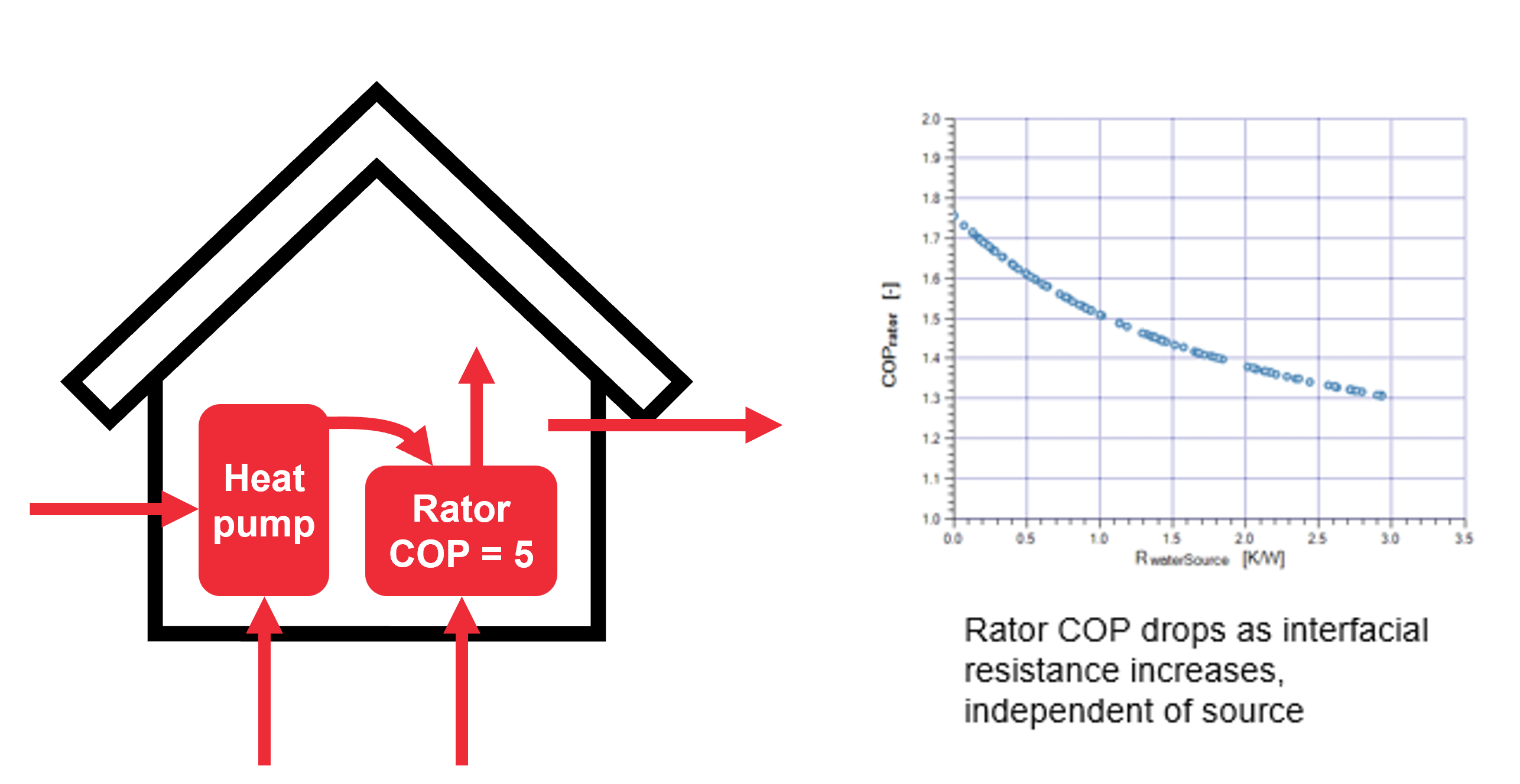
Reden made a high level model of a heating system with and without the Rator concept as it was being developed. The concept was analysed using general thermodynamic principles. The results were unexpected and counter-intuitive. It turned out that a high COP for the Rator concept did not lead to a high COP for the whole heating system, despite the increase in efficiency of the main heater (either a gas boiler or a heat pump). As a consequence, the Rator concept appeared unnecessarily expensive for the envisaged use case. The only conclusion could be that, although the basic idea of Rator was a good one, the embodiment as developed by Rator could not deliver on the claims Rator wanted to make. In addition, a detailed model of the thermal performance of a Rator device was made, and simulation results compared to experimental data.
What next?
”Reden understands innovation” is our claim, so we realise that having a good idea is just the first step of developing an innovative product. Setbacks must be expected, and new directions must be found. Was Rator prepared to accept the Reden findings? Was Rator able to change tack regarding the embodiment? It is not easy to abandon a concept; could a new use case be found?
In any case, the value of the JumpStart had become very clear. Rator stated it would have been better to do the JumpStart earlier. However, inventors sometimes need to explore a bit before they team up with the established specialists in the field they explore; this is how new inventions are made: the existing truths are challenged. On the other hand, technology can change, but physics is constant (although human understanding of physics has evolved over time). Finding a balance between the passion of the explorer and the cold realism of the critic is necessary.
The basic idea of Rator was sound, but it needs a new twist, and although Reden had the role of critic in this case, we cannot suppress our passion for innovation. The same applies to Rator, so it makes sense to combine our skills for the new Rator product. We look forward to this co-operation. For the result, you will have to have patience. It will, in due time, feature in a new Reden Makes Sense column.
Conclusion
The present case shows that it’s never too late for a JumpStart. It was designed for an early stage in development, but can be applied in a later stage too. An independent eye, combined with experience in development of innovative products, can reveal the real benefits of an idea and the remaining weaknesses. Good understanding of a problem usually suggests new ideas and embodiments that are not considered otherwise. In development, action is often preferred to theoretical work, but the start of action should never be the end of thinking. You know you have taken a good route when you arrive at your destination, but without proper navigation, you may never arrive.
The aim of JumpStart is to help innovation. Ideally, this is by confirming the product is worthy of further development, and deserves investment. In this case, JumpStart helps innovation by showing a new development direction of a good basic idea.


