

Sometimes the best Innovation decision is to stop
What if the most valuable outcome of an innovation project is not a working prototype, but the decision not to build one?
That may sound counterintuitive. Innovation is about moving forward, after all. But moving forward only makes sense when you know you are moving in the right direction.
Sometimes an inevitable development needs a trigger to set it off. In the case of Jumpstart, this trigger was a request from an inventor who came to us with an investing party. Before investing properly, the investor wanted to know if a problem that arose during development was a show stopper, or something that could be solved.
The problem concerned something almost everyone who drives a car will have experienced.
A small drop, a real problem
The invention was a device to prevent fuel leakage from the filling spout at service stations. You have probably noticed that a small amount of fuel leaks from the spout after it is disengaged from the car. In the case of diesel fuel, these leaks tend to accumulate, leading to a greasy and smelly handle. In the case of petrol, the fuel soon evaporates, which is not environmentally friendly. A solution to this problem would be popular.
A good idea meets a 100-year-old mechanism
The inventor had found a prospective investor, and this was a clever man. He liked the idea but he lacked the knowledge to judge the technical feasibility. The inventor, meanwhile, had identified a problem. His main idea was fully functional, but it interfered with the automatic shut-off device in the spout.
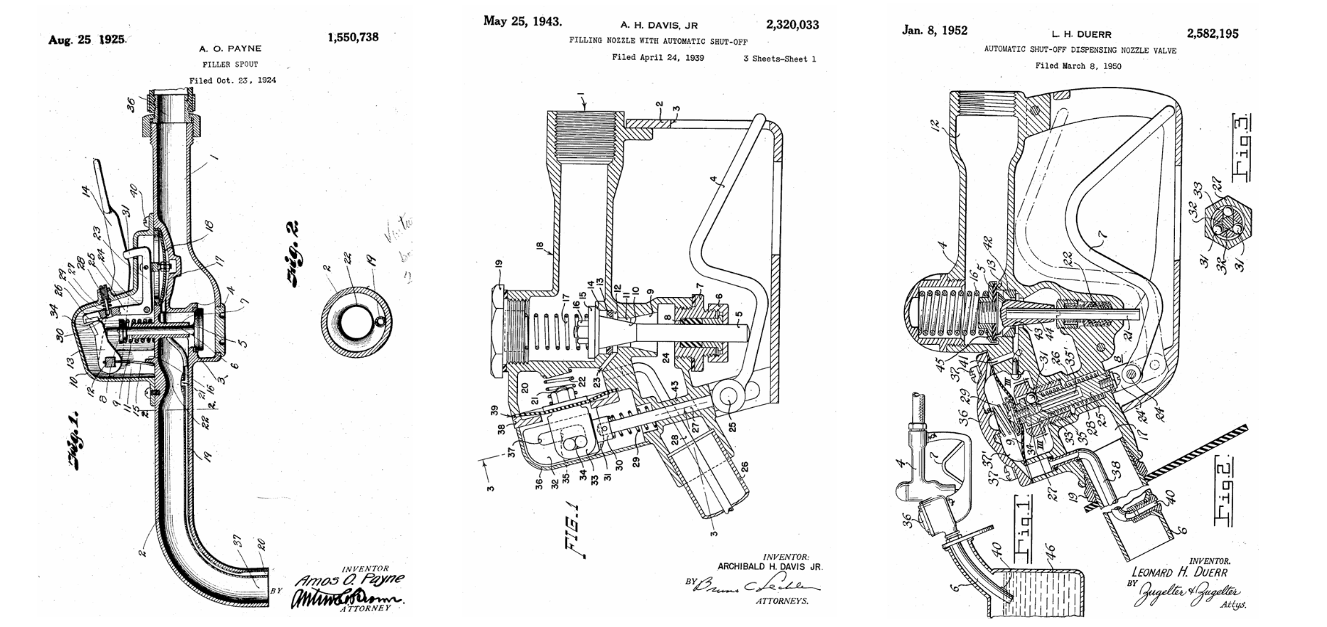
The automatic shut-off mechanism was first patented by A.O. Payne in 1925 (US patent 1550738), with improvements by A.H. Davis in 1943 (US patent 2320033), and L.H. Duerr in 1952 (US patent 2582195). The mechanisms rely on an open connection at the end of the spout, where a small channel ends. As long as air can enter the channel, the spout continues to be open, and fuel can flow. As soon as the channel is closed off by the fuel level, the mechanism closes. The mechanism is very robust and does not rely on electronic sensors and electric actuators. It is still used around the globe.
The problem that the inventor identified was that the fuel spilling prevention device rendered the automatic shut-off mechanism inoperable. It was with this problem that the inventor and the investor came to Reden. There was a good idea, there was the money to support it, and there was an embodiment with just one remaining flaw. Could this be made to work?
The answer was no. And that was valuable.
Reden made an analysis of the problem, and this made clear what would be needed to repair the embodiment. However, the business case relied on the product as an add-on to existing filling spouts. The intention was to fit a simple extra to the spouts, whatever their manufacture. This limited the solution space such that a new embodiment could not be designed.
Therefore, the project was cancelled. The inventor and investor avoided the expense of time, effort and money, in exchange for a small payment for the Jumpstart. The Jumpstart did not, in this case, alter the technical outcome, but made it available much sooner. And that distinction matters.
From one technical question to a method
Jumpstart did not exist when the filling spout case was analysed, but this case gave rise to the start of Jumpstart as a defined method.
It had shown how a short time spent on analysis could give answers to questions which might have remained unanswered for a long time. In that long time, many prototypes might have been built and tested. The Jumpstart approach saved time and money and gave certainty. It also gave a clear view of what would have been needed to design a working prototype. It brought the inventor and the investor to the point where both had the facts needed to decide whether or not to go forward.
This inspired Reden to offer Jumpstart as a service to other people in the same situation.
We can bring our expertise in innovation to a situation where an inventor must convince an investor but does not have all the answers (since not all the work can be done without investment). Jumpstart can also be used by an investor who has found an appealing idea but needs to convince himself or herself that the inventor can give an impartial and accurate impression of the product.
The lasting result of this small project was the Jumpstart method. We hope it helps innovation by setting in motion developments which promise to generate business and strengthen the position of Europe as an innovative continent.
Knowing when to move forward
A good idea does not automatically lead to a successful product.
It pays to have an innovation-oriented technical expert look at the idea. The outcome may be confirmation of the planned actions, a recommendation to make changes or, sometimes, the advice to stop in time and think of a new innovative idea. The trick is to do this early in the development process, before the large spending starts.
Because sometimes the most valuable step forward is finding out early that you shouldn’t take the next one.


