
People who went to places where they risked being bitten by a deadly venomous snake would sometimes carry a safety razor blade, with which they were advised to make an incision, preferably two at right angles, across the bite wound. The blood rushing out was meant to flush the venom out. The razor blade should give a clean cut which healed without too many marks. This method is now discouraged [1], but there are three positive points to notice:
- A safety razor blade takes up hardly any space and can be safely carried in a wallet.
- It can do something you cannot do nearly so well without it.
- It is very cheap.
These three points made it an easy precaution for an unlikely emergency.
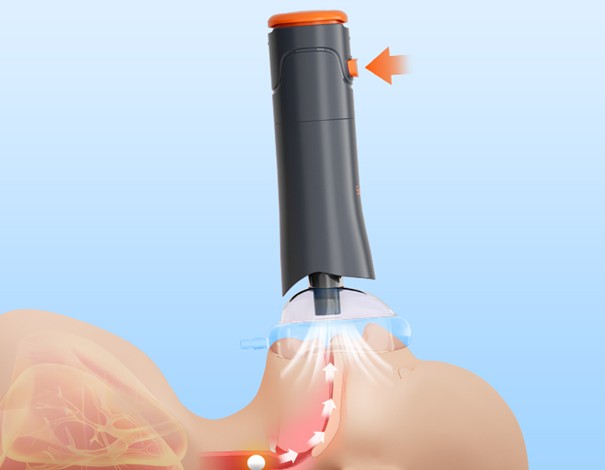
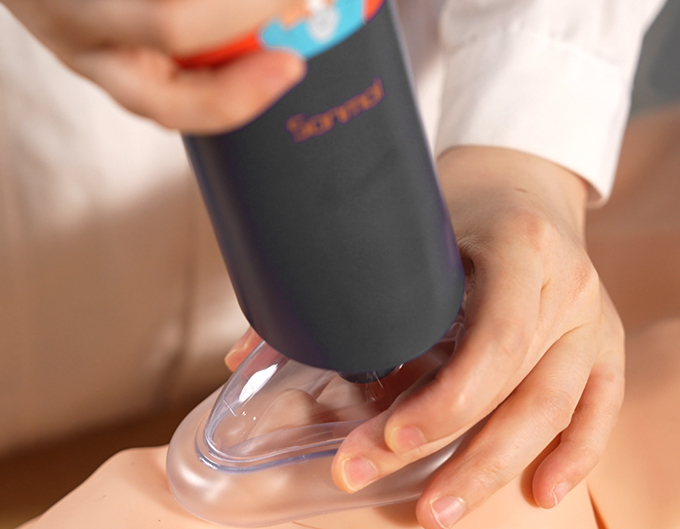
On linkedIn, a new device is shown in a video called “Make way, Heimlich Maneuver, it’s time for the portable, on-button suction tool” (it is not easy to include a link here). The device can be found on the internet [2], so it is not a joke, unless it is an elaborate one. The website also shows a manual anti-choking device which is “Simple to use – just place, push, and pull to help save lives when the Heimlich maneuver fails.” It is not clear that this claim can be substantiated. Wikipedia states that the Heimlich maneuver has saved many lives but is nevertheless not supported by enough clinical evidence [3]. About mechanical devices, it is also critical.
What can Reden Makes Sense say about the LinkedIn post and the Portable Choking Rescue Device (PCRD)? Is this a good example of innovation?
Innovative merit
Innovation should be about solving a problem in a new, better way, without introducing new problems. Small problems which are much smaller than the original problem can be tolerated.
Without clinical trials, involving very uncomfortable choking experiments on healthy volunteers, the technical merit of the PCRD cannot be compared with that of the Heimlich maneuver. There is, however, a very important problem with the portable device: it has to be carried. Many people live long lives without witnessing anyone choking in their presence. Dr. Heimlich himself applied the technique for the first time on a real choking victim when he (Dr. Heimlich) was 96 years of age [4]. This was just before he died, and 42 years after he had invented the maneuver.
The claim that the PCRD could replace the Heimlich maneuver is, therefore, ridiculous. No one would carry the device with him to every breakfast, lunch and dinner, year after year, when the same effect can be achieved with his or her own hands.
The only possible application could be in a home for people at high risk of choking, where there is a high chance of needing the device.
The rest of the population will have to rely on the 1974 invention which requires no device, the Heimlich maneuver. The title of the LinkedIn video is non-sensical. So is the claim on the Sonmolmed website; if you have the device, why try Heimlich first? The reality will almost always be that there is no choice because no one carries a device he almost certainly never has any use for, and which is not really necessary when it can be used.
Technical
There is an essential difference between the Heimlich maneuver and the PCRD. The former causes a positive pressure on the inside of the blockage. This means that the effect is automatically directed to the problem spot. The PCRD, on the other hand, applies suction on the mouth. This suction then acts on both tracts connected to the mouth: the esophagus leading to the stomach and the trachea leading to the lungs. If the blockage is firm, stomach content can be sucked back into the esophagus, where it can do harm. Worse still, if the blockage turns out to be on the esophagus side (i.e. the patient is not choking, but has a piece of food stuck in his throat, the suction can lead to damage in the lung (pulmonary edema, a potentially deadly condition). There is an FDA warning against unauthorized anti-choking devices [5].
It is clear that the PCRD has problems the Heimlich manoever does not have, and that it may cause deadly problems instead of saving a life.
Conclusion
The Portable Choking Rescue Device is not an innovation. The claims made by its producer are very dubious, and the safety of the device is in question. Even if it works, the use scenario is so inferior to the alternative that it cannot be considered a useful invention.
The underlying idea may seem creative and original, but closer inspection shows it solves a solved problem, but in a much worse way. In cases like this, the Reden JumpStart (Jumpstart - For innovators and investors) can be very useful!
[1] 11 Ways to Survive Being Bitten by a Venomous Snake - wikiHow Health
[2] Portable Choking Rescue Device - sonmolmed
[4] Henry Heimlich uses Heimlich maneuver for first time to save choking woman | CNN


